
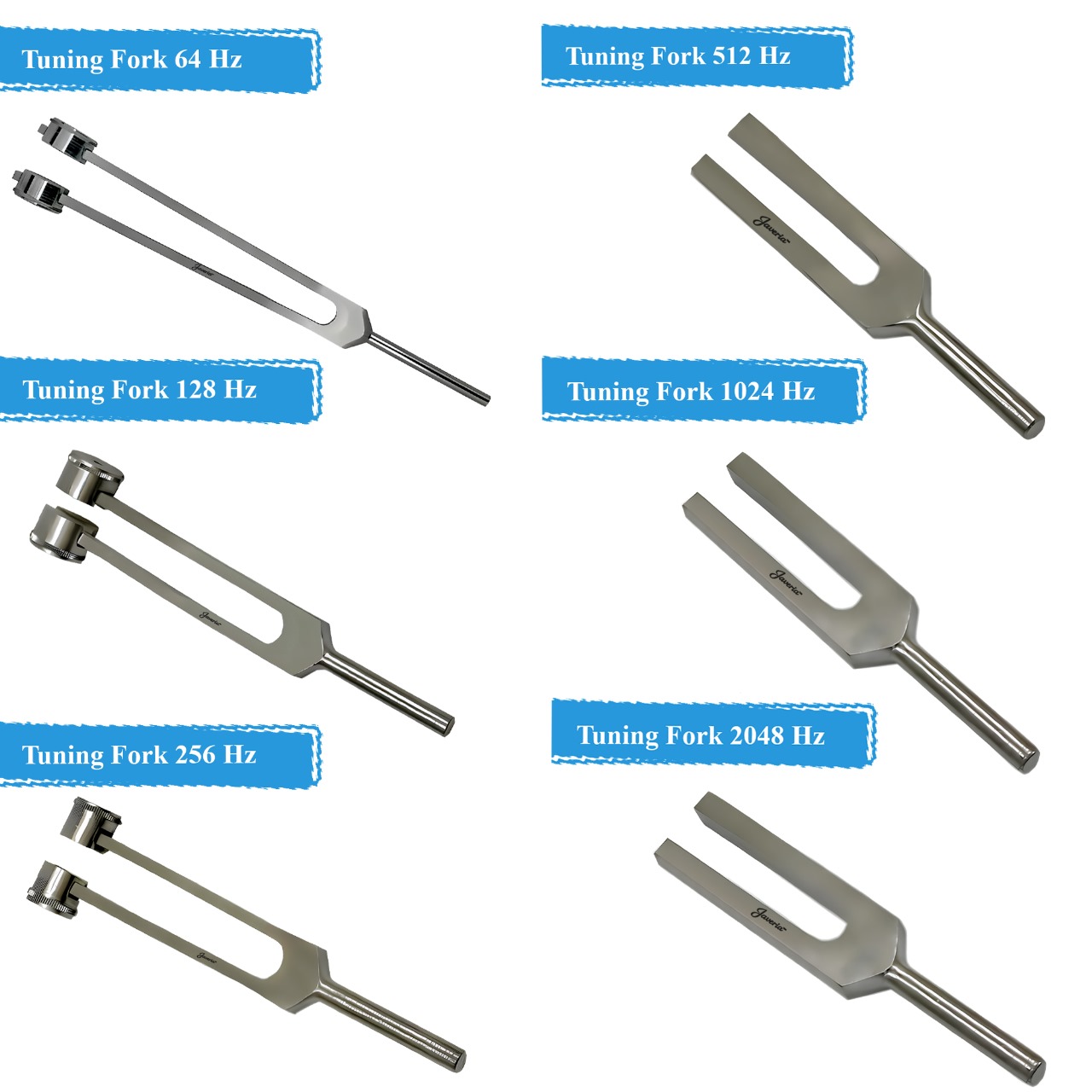
Tuning Forks
Original price was: $ 21.38.$ 19.24Current price is: $ 19.24.

A Medical Tuning Fork is a diagnostic instrument used to assess hearing sensitivity and vibratory sensation during neurological and audiological examinations.
-
Purpose: Tests hearing (air/bone conduction) and vibration sense.
-
Frequencies Available: Commonly 128 Hz, 256 Hz, 512 Hz, 1024 Hz.
-
Material: High-quality aluminum or stainless steel for accurate tuning.
-
Design: Two-prong (U-shaped) fork with a stem for placement on the body.
-
Types: Weighted (for vibratory testing) and unweighted (for hearing tests).
-
Applications: Audiology, neurology, endocrinology, physical examinations.
-
Durability: Reusable, easy to clean, and resistant to corrosion.


Related products

Medical Tuning Forks

Medical Tuning Forks
A Medical Tuning Fork is a precision diagnostic tool commonly used by healthcare professionals to evaluate auditory function and peripheral nerve health. It consists of a two-pronged metal fork with a stem that, when struck, vibrates at a specific frequency. These vibrations can be used to assess a patient’s ability to hear sound through air and bone conduction, or to feel vibration on bony prominences.
Tuning forks are used in hearing tests (such as Rinne and Weber tests) to help distinguish between conductive and sensorineural hearing loss. In neurological examinations, particularly in diabetes or spinal cord conditions, tuning forks help assess vibration sense — an important indicator of peripheral nerve function.
Available in various frequencies, each serves a specific purpose:
-
128 Hz – Preferred for testing vibratory sensation on joints and bones.
-
256 Hz & 512 Hz – Standard for general hearing assessments.
-
1024 Hz – Occasionally used for more refined hearing tests.
Most medical tuning forks are made from aluminum for lightweight use and long-lasting resonance, and they may come weighted (for prolonged vibration) or unweighted depending on the clinical requirement.
| Please select the size | 1024 Hz, 128 Hz, 2048 Hz, 256 Hz, 512 Hz, 64 Hz |
|---|
Reviews
There are no reviews yet.